Boom Lift Rental in India: Types, Costs, and How to Choose the Right Machine
If you've ever stood on a construction site and watched a crew work forty metres up a building facade without a single piece of scaffolding in sight, you've seen a boom lift at work. For anyone specifying equipment for the first time, "boom lift rental in India" turns up thousands of listings and almost no real guidance on which machine actually fits a given job. This guide is written from the rental side of that conversation. The questions site and project managers actually ask us before they book.
What Is a Boom Lift and When Do You Need One?
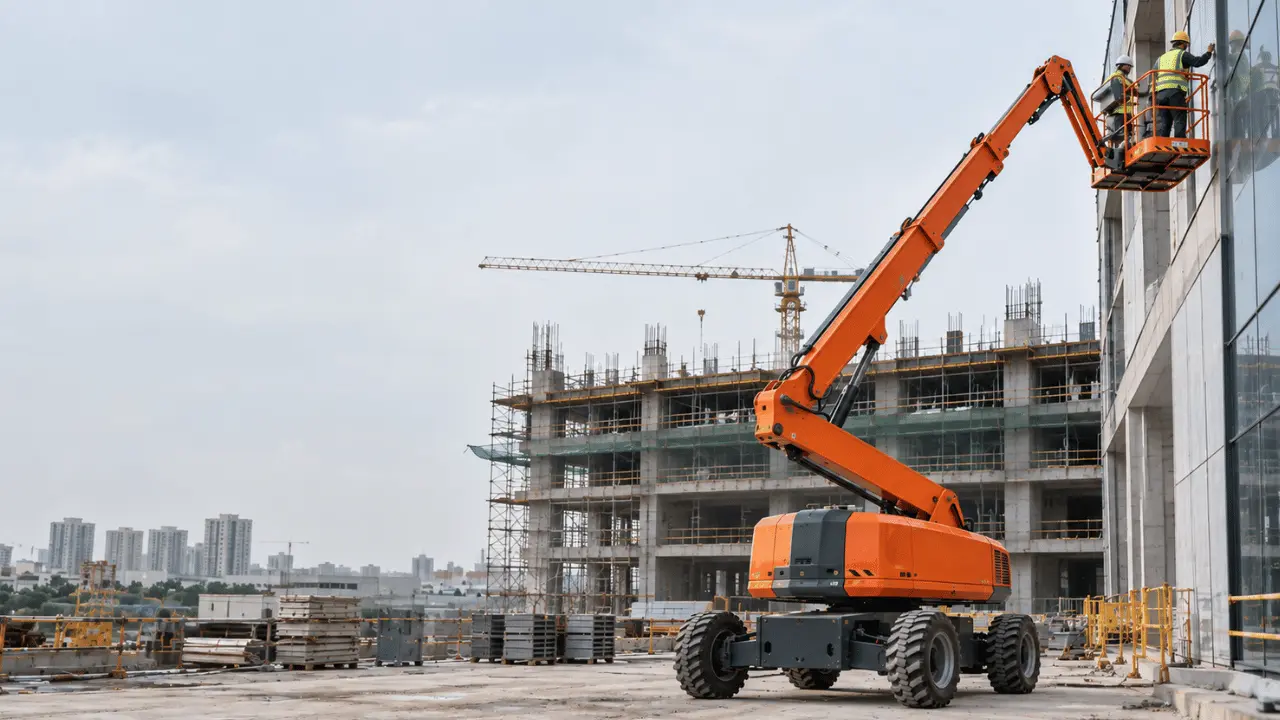
A boom lift is a type of aerial work platform (AWP): a powered machine with a platform mounted on an articulating or telescoping arm, used to lift one or two workers and their tools to height. Unlike scaffolding, a boom lift can be repositioned in minutes, reaches over obstacles rather than around them, and needs no assembly or dismantling crew.
Boom lifts earn their keep whenever the job needs height plus horizontal reach. Not just straight-up access. Typical use cases include:
- Facade work, cladding, and glazing on mid- and high-rise buildings
- Structural steel erection and bolting at height
- MEP (mechanical, electrical, plumbing) installation in warehouses and factories
- Signage, lighting, and telecom tower maintenance
- Tree and vegetation work along roads and rail corridors
If your task only needs you to go straight up over a flat, stable surface, a scissor lift is usually the more cost-effective choice. We cover that decision in detail in our scissor lift vs. boom lift guide.
Articulating vs. Telescopic Boom Lifts: Key Differences
Every boom lift on the market falls into one of two mechanical families, and the difference matters more than most rental conversations make clear.
Articulating booms have multiple knuckle joints, like an elbow and a wrist. This lets the platform reach up, over, and around an obstacle (a parapet wall, a piece of existing structure, a tree) in a way a straight boom simply can't. They're the right choice whenever the path to the work point isn't a straight line.
Telescopic booms extend in a single straight line, like a fishing rod. They sacrifice the ability to reach "around" things but deliver significantly greater horizontal outreach from a single footprint, which matters on large open sites such as stadiums, bridges, and industrial plants, where repositioning the machine isn't practical.
A simple way to decide: if you can draw a straight line from where the machine can stand to where the work needs to happen, telescopic usually wins on reach and stability. If that line is blocked by something, articulating wins on flexibility.
Boom Lift Working Height Ranges Explained (12m–43m+)
Our boom lift fleet covers working heights from 12 metres to 43 metres, spanning both articulating and telescopic models, with indoor and outdoor capability depending on the unit. In practice, height requirements break down roughly like this:
- 12m–18m: low-rise facade and maintenance work, warehouse mezzanine installation, signage
- 18m–28m: mid-rise construction, structural steel, most commercial facade projects
- 28m–43m+: high-rise facade, large industrial plant maintenance, telecom and power infrastructure
It's worth specifying height generously rather than exactly. A machine rated close to the required working height often can't actually reach that height at full horizontal outreach, because platform capacity and reach are interdependent. The manufacturer's load chart, not the headline height figure, tells you what the machine can actually do at your specific combination of height and reach.
What Drives Boom Lift Rental Cost in India
We're deliberately not publishing a "starting from ₹X/day" number here, because a bare headline rate is close to meaningless without the variables that actually move it. The real cost drivers are:
- Machine category and height. A 43m telescopic unit costs meaningfully more to operate and transport than a 12m electric scissor-style boom, independent of any "deal."
- Rental duration. Day rates, weekly rates, and monthly rates are structured differently. A two-week job booked as a daily rate is almost always more expensive than the same job booked on a monthly term.
- Transport and mobilization. Getting a 40m+ machine to a remote site, including any permits for oversized road transport, is a real line item. This is where "pan-India" rental network coverage genuinely changes your total cost versus a single-city operator.
- Operator requirement. Certified-operator-included rentals cost more per day than bare-machine hire, but they remove a liability and scheduling burden from your side. See our guide on IPAF certification for why this matters more than it first appears.
- Fuel type. Diesel units have different running costs than electric units, and electric is frequently mandatory for indoor or emissions-restricted sites.
- Standby and breakdown terms. What happens if the machine goes down on day three of a two-week rental is a cost question as much as an operational one.
The honest answer to "how much does a boom lift cost to rent in India" is: ask for a quote against your specific height, duration, location, and operator requirement. Anyone quoting a single flat number without asking those questions isn't giving you a usable estimate.
Boom Lift vs. Scissor Lift vs. Spider Lift: Choosing the Right Category
Boom lifts aren't always the right answer, and a good rental partner will tell you that before you book, not after.
- Choose a boom lift when you need reach over an obstacle or significant horizontal outreach from a fixed base.
- Choose a scissor lift when the work is straight-up access on a flat, stable surface and you need a larger platform for materials or multiple workers.
- Choose a spider lift (tracked/compact lift) when you need height but the access point is narrow, uneven, or indoors with weight restrictions. Our spider and truck-mounted units handle these specialized access scenarios where a standard boom or scissor footprint won't fit.
Safety & Certification: What to Check Before You Rent
Three things worth confirming before any boom lift arrives on site:
- CE-marked equipment, meeting the Machinery Directive and EN 280 (the specific standard for aerial work platforms). We cover exactly what this certification does and doesn't guarantee in our CE certification guide.
- IPAF-certified operators, if you're hiring operated equipment. A certified operator has been trained specifically on the machine category (boom vs. scissor vs. vertical mast) they're running, which matters for both safety and your own liability exposure.
- Load chart compliance. Confirm the platform capacity at your required height and reach, not just the maximum headline figures.
How to Choose a Boom Lift Rental Partner: A Checklist
- Do they ask about height and horizontal reach, or just height?
- Can they confirm fleet availability for your specific dates before you commit?
- Is their fleet CE-certified, and can they show documentation on request?
- Do they offer certified operators, or bare-machine hire only?
- What's their stated response time if a machine needs servicing mid-project?
- Can they mobilize equipment to your site location, including any permits for oversized transport?
CE Infrastructure LLP maintains working heights from 12m to 43m across articulating and telescopic models, with pan-India mobilization and a 97% fleet uptime record backed by preventive maintenance and backup availability. We've supported facade, structural, and maintenance access work for clients including L&T, JSW, Adani, and Tata.
FAQs
What's the difference between an articulating and telescopic boom lift? Articulating booms have multiple joints and can reach up and over obstacles; telescopic booms extend in a straight line and offer greater horizontal reach from a single position.
What height boom lift do I need for a 4-storey building? Most 4-storey facade work falls in the 18m–28m range, but the exact machine depends on required horizontal outreach at that height, not just the building's height alone.
Can boom lifts be used indoors? Yes. Electric models are commonly used indoors, particularly in warehouses and manufacturing facilities, though ceiling height and floor load capacity need to be confirmed first.
Do I need a certified operator to rent a boom lift? It isn't a universal legal requirement in India in every context, but an IPAF-certified operator substantially reduces safety risk and liability exposure, which is why most serious rental partners recommend or require it.